About the Report
Base Year 2024South Africa Renewable Microgrids Market Overview
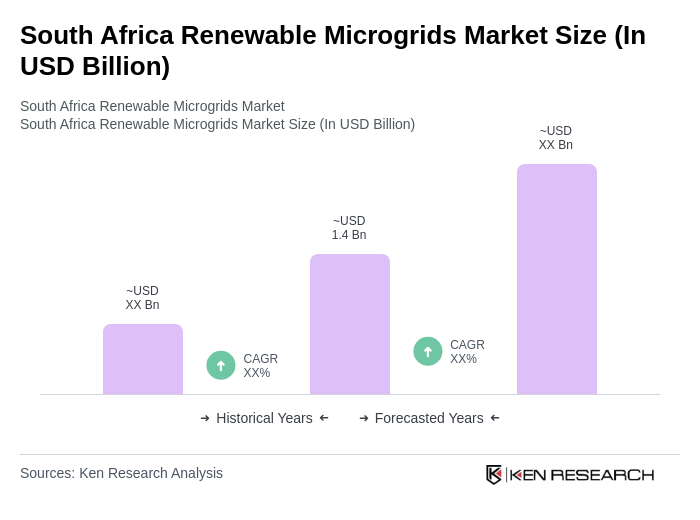
- The South Africa Renewable Microgrids Market is valued at USD 1.4 billion, based on a five-year historical analysis. This growth is primarily driven by the increasing demand for reliable and sustainable energy solutions, particularly in remote and off-grid areas. The rising awareness of climate change, frequent power outages, and the need for energy independence have further propelled investments in renewable microgrid technologies. Rapid technological advancements in energy storage and smart control systems are also accelerating adoption .
- Key cities such as Cape Town, Johannesburg, and Durban dominate the market due to their significant energy needs, ongoing urbanization, and higher rates of commercial and residential construction. These urban centers are also home to various public and private initiatives aimed at enhancing energy resilience and sustainability, making them attractive locations for renewable microgrid projects .
- The Renewable Energy Independent Power Producer Procurement Programme (REIPPPP), issued by the Department of Mineral Resources and Energy in 2011 and updated in subsequent rounds, is the primary regulatory framework facilitating the development of renewable energy projects, including microgrids. The REIPPPP encourages private sector participation, sets clear procurement processes, and mandates compliance with technical, financial, and environmental standards to increase the share of renewable energy in the national grid .
South Africa Renewable Microgrids Market Segmentation
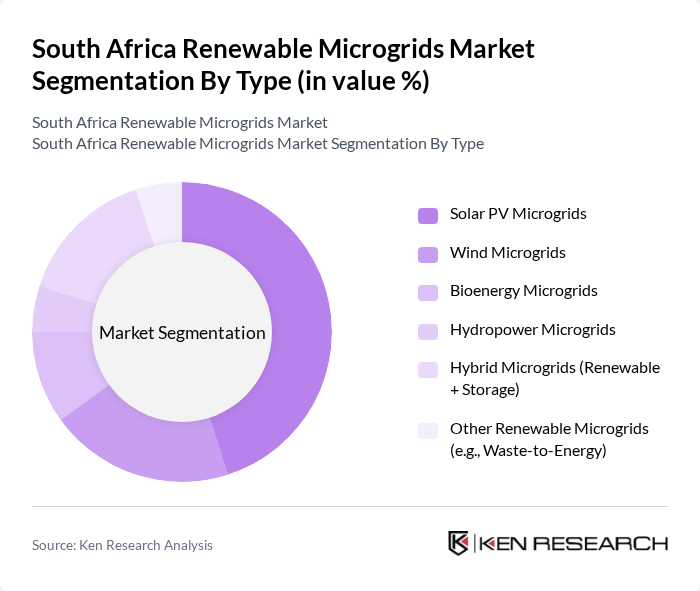
By Type:The market is segmented into various types of renewable microgrids, including Solar PV Microgrids, Wind Microgrids, Bioenergy Microgrids, Hydropower Microgrids, Hybrid Microgrids (Renewable + Storage), and Other Renewable Microgrids (e.g., Waste-to-Energy). Among these, Solar PV Microgrids are leading the market due to their scalability, decreasing costs, and the abundant solar resources available in South Africa. The growing trend towards decentralized energy generation and the increasing adoption of solar technologies in both urban and rural areas further bolster this segment's dominance. Hybrid microgrids, which integrate battery storage, are also gaining traction as organizations seek greater energy resilience and cost savings .
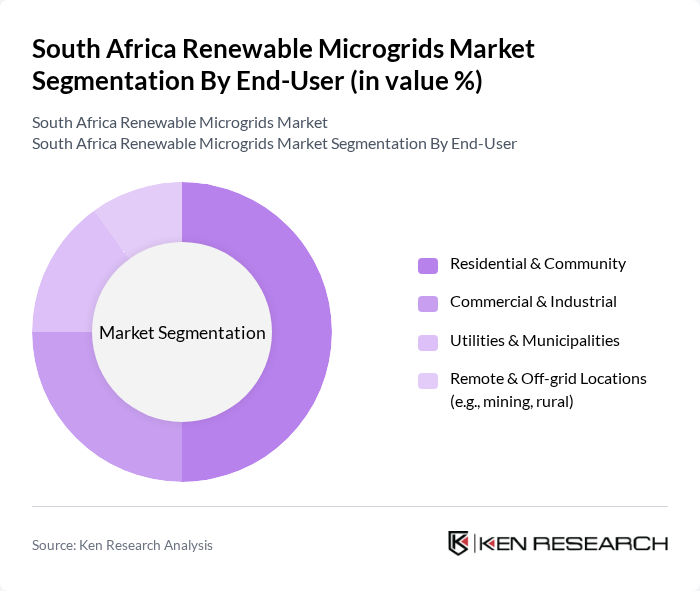
By End-User:The end-user segmentation includes Residential & Community, Commercial & Industrial, Utilities & Municipalities, and Remote & Off-grid Locations (e.g., mining, rural). The Residential & Community segment is currently the most significant contributor to the market, driven by the increasing need for energy access in underserved areas and the growing trend of energy independence among households. The rise in community-based renewable energy projects and the need for backup power during grid outages also support this segment's growth. The Commercial & Industrial segment is expanding rapidly as businesses seek to improve energy efficiency and reduce operational risks associated with unreliable grid supply .
South Africa Renewable Microgrids Market Competitive Landscape
The South Africa Renewable Microgrids Market is characterized by a dynamic mix of regional and international players. Leading participants such as SolarAfrica Energy, Enel Green Power South Africa, DNV, Siemens Gamesa Renewable Energy, JinkoSolar, SunPower Corporation, ABB South Africa, Schneider Electric South Africa, SOLA Group, Eskom Holdings SOC Ltd, Mainstream Renewable Power South Africa, GreenCape, PowerX, juwi Renewable Energies (Pty) Ltd, and Bboxx contribute to innovation, geographic expansion, and service delivery in this space.
South Africa Renewable Microgrids Market Industry Analysis
Growth Drivers
- Increasing Energy Demand:South Africa's energy demand is projected to reach 220 terawatt-hours (TWh) by future, driven by urbanization and industrial growth. The country's population is expected to grow to approximately 60 million, increasing the need for reliable energy sources. This rising demand is pushing the government and private sector to explore renewable microgrids as a viable solution to meet energy needs sustainably and efficiently, particularly in underserved areas.
- Government Support and Incentives:The South African government has allocated over ZAR 200 billion (approximately USD 13 billion) in incentives for renewable energy projects in future. This includes tax breaks and grants aimed at promoting microgrid installations. The Renewable Energy Independent Power Producer Procurement Programme (REIPPPP) has successfully attracted investments exceeding ZAR 200 billion (USD 13 billion) since its inception, demonstrating strong governmental commitment to renewable energy development.
- Technological Advancements:The cost of solar photovoltaic (PV) systems has decreased by 82% since 2010, making renewable microgrids more accessible. In future, the average cost of solar PV installations is expected to be around ZAR 10,000 (USD 600) per kilowatt. Additionally, advancements in energy storage technologies, such as lithium-ion batteries, are enhancing the reliability and efficiency of microgrids, enabling them to operate independently from the main grid during peak demand periods.
Market Challenges
- High Initial Investment Costs:The upfront costs for establishing renewable microgrids can be substantial, often exceeding ZAR 1 million (USD 60,000) for small-scale projects. This financial barrier can deter potential investors and local communities from pursuing microgrid solutions. Despite long-term savings, the initial capital required poses a significant challenge, particularly in rural areas where funding is limited and access to financing options is scarce.
- Regulatory Uncertainties:The South African energy sector faces regulatory challenges that can hinder the growth of renewable microgrids. In future, the lack of clear policies regarding grid interconnections and licensing requirements may create confusion for investors. Additionally, frequent changes in government regulations can lead to uncertainty, making it difficult for stakeholders to plan and invest in microgrid projects with confidence, ultimately slowing market growth.
South Africa Renewable Microgrids Market Future Outlook
The future of the South African renewable microgrids market appears promising, driven by increasing energy demands and supportive government policies. As technological advancements continue to lower costs and improve efficiency, more communities are likely to adopt microgrid solutions. Furthermore, the integration of smart grid technologies will enhance energy management and resilience. With a focus on sustainability, the market is expected to evolve, fostering innovation and collaboration among stakeholders to address energy challenges effectively.
Market Opportunities
- Rural Electrification Projects:With approximately 2.3 million households in South Africa lacking access to electricity, rural electrification projects present a significant opportunity. Implementing microgrids in these areas can provide reliable energy access, improving living standards and economic development. The government’s commitment to electrifying rural communities further supports this initiative, creating a favorable environment for investment.
- Partnerships with Local Governments:Collaborating with local governments can enhance the deployment of renewable microgrids. By leveraging local knowledge and resources, these partnerships can facilitate project implementation and community engagement. In future, initiatives that involve local stakeholders are likely to gain traction, as they can address specific energy needs and foster sustainable development, ultimately leading to successful microgrid projects.
Scope of the Report
| Segment | Sub-Segments |
|---|---|
| By Type | Solar PV Microgrids Wind Microgrids Bioenergy Microgrids Hydropower Microgrids Hybrid Microgrids (Renewable + Storage) Other Renewable Microgrids (e.g., Waste-to-Energy) |
| By End-User | Residential & Community Commercial & Industrial Utilities & Municipalities Remote & Off-grid Locations (e.g., mining, rural) |
| By Application | Grid-Connected Microgrids Off-Grid/Islanded Microgrids Backup/Resilience Microgrids Peer-to-Peer Energy Trading Microgrids |
| By Investment Source | Domestic Private Investment Foreign Direct Investment (FDI) Public-Private Partnerships (PPP) Government & Development Finance |
| By Policy Support | Subsidies & Grants Tax Incentives & Exemptions Renewable Energy Certificates (RECs) |
| By Distribution Mode | Direct Project Sales EPC (Engineering, Procurement, Construction) Contracts Energy-as-a-Service (EaaS) Models |
| By Price Range | Low-Cost Microgrids Mid-Range Microgrids Premium/High-Capacity Microgrids |
Key Target Audience
Investors and Venture Capitalist Firms
Government and Regulatory Bodies (e.g., Department of Mineral Resources and Energy, National Energy Regulator of South Africa)
Energy Utilities and Service Providers
Microgrid Technology Developers
Renewable Energy Project Developers
Local Municipalities and Authorities
Non-Governmental Organizations (NGOs) focused on energy access
Financial Institutions and Banks specializing in renewable energy financing
Players Mentioned in the Report:
SolarAfrica Energy
Enel Green Power South Africa
DNV
Siemens Gamesa Renewable Energy
JinkoSolar
SunPower Corporation
ABB South Africa
Schneider Electric South Africa
SOLA Group
Eskom Holdings SOC Ltd
Mainstream Renewable Power South Africa
GreenCape
PowerX
juwi Renewable Energies (Pty) Ltd
Bboxx
Table of Contents
Market Assessment Phase
1. Executive Summary and Approach
2. South Africa Renewable Microgrids Market Overview
2.1 Key Insights and Strategic Recommendations
2.2 South Africa Renewable Microgrids Market Overview
2.3 Definition and Scope
2.4 Evolution of Market Ecosystem
2.5 Timeline of Key Regulatory Milestones
2.6 Value Chain & Stakeholder Mapping
2.7 Business Cycle Analysis
2.8 Policy & Incentive Landscape
3. South Africa Renewable Microgrids Market Analysis
3.1 Growth Drivers
3.1.1 Increasing Energy Demand
3.1.2 Government Support and Incentives
3.1.3 Technological Advancements
3.1.4 Environmental Sustainability Initiatives
3.2 Market Challenges
3.2.1 High Initial Investment Costs
3.2.2 Regulatory Uncertainties
3.2.3 Infrastructure Limitations
3.2.4 Competition from Traditional Energy Sources
3.3 Market Opportunities
3.3.1 Rural Electrification Projects
3.3.2 Partnerships with Local Governments
3.3.3 Expansion of Renewable Energy Policies
3.3.4 Technological Innovations in Energy Storage
3.4 Market Trends
3.4.1 Decentralization of Energy Production
3.4.2 Integration of Smart Grid Technologies
3.4.3 Increased Investment in Renewable Energy
3.4.4 Focus on Energy Resilience
3.5 Government Regulation
3.5.1 Renewable Energy Independent Power Producer Procurement Programme (REIPPPP)
3.5.2 National Development Plan (NDP)
3.5.3 Integrated Resource Plan (IRP)
3.5.4 Feed-in Tariffs for Renewable Energy
4. SWOT Analysis
5. Stakeholder Analysis
6. Porter's Five Forces Analysis
7. South Africa Renewable Microgrids Market Market Size, 2019-2024
7.1 By Value
7.2 By Volume
7.3 By Average Selling Price
8. South Africa Renewable Microgrids Market Segmentation
8.1 By Type
8.1.1 Solar PV Microgrids
8.1.2 Wind Microgrids
8.1.3 Bioenergy Microgrids
8.1.4 Hydropower Microgrids
8.1.5 Hybrid Microgrids (Renewable + Storage)
8.1.6 Other Renewable Microgrids (e.g., Waste-to-Energy)
8.2 By End-User
8.2.1 Residential & Community
8.2.2 Commercial & Industrial
8.2.3 Utilities & Municipalities
8.2.4 Remote & Off-grid Locations (e.g., mining, rural)
8.3 By Application
8.3.1 Grid-Connected Microgrids
8.3.2 Off-Grid/Islanded Microgrids
8.3.3 Backup/Resilience Microgrids
8.3.4 Peer-to-Peer Energy Trading Microgrids
8.4 By Investment Source
8.4.1 Domestic Private Investment
8.4.2 Foreign Direct Investment (FDI)
8.4.3 Public-Private Partnerships (PPP)
8.4.4 Government & Development Finance
8.5 By Policy Support
8.5.1 Subsidies & Grants
8.5.2 Tax Incentives & Exemptions
8.5.3 Renewable Energy Certificates (RECs)
8.6 By Distribution Mode
8.6.1 Direct Project Sales
8.6.2 EPC (Engineering, Procurement, Construction) Contracts
8.6.3 Energy-as-a-Service (EaaS) Models
8.7 By Price Range
8.7.1 Low-Cost Microgrids
8.7.2 Mid-Range Microgrids
8.7.3 Premium/High-Capacity Microgrids
9. South Africa Renewable Microgrids Market Competitive Analysis
9.1 Market Share of Key Players
9.2 Cross Comparison of Key Players
9.2.1 Company Name
9.2.2 Company Size (Large, Medium, Small)
9.2.3 Installed Microgrid Capacity (MW)
9.2.4 Number of Microgrid Projects Deployed
9.2.5 Revenue from Microgrid Solutions (USD/ZAR)
9.2.6 Market Share (%)
9.2.7 Average Project Size (MW)
9.2.8 Project Pipeline (MW or # of projects)
9.2.9 Technology Portfolio Breadth (e.g., solar, wind, storage, hybrid)
9.2.10 Geographic Reach within South Africa
9.2.11 Key Partnerships/Consortium Participation
9.2.12 Operational Efficiency (e.g., project delivery time, O&M cost/MW)
9.2.13 Return on Investment (ROI)
9.2.14 Customer Segments Served
9.2.15 ESG Performance/Impact Metrics
9.3 SWOT Analysis of Top Players
9.4 Pricing Analysis
9.5 Detailed Profile of Major Companies
9.5.1 SolarAfrica Energy
9.5.2 Enel Green Power South Africa
9.5.3 DNV
9.5.4 Siemens Gamesa Renewable Energy
9.5.5 JinkoSolar
9.5.6 SunPower Corporation
9.5.7 ABB South Africa
9.5.8 Schneider Electric South Africa
9.5.9 SOLA Group
9.5.10 Eskom Holdings SOC Ltd
9.5.11 Mainstream Renewable Power South Africa
9.5.12 GreenCape
9.5.13 PowerX
9.5.14 juwi Renewable Energies (Pty) Ltd
9.5.15 Bboxx
10. South Africa Renewable Microgrids Market End-User Analysis
10.1 Procurement Behavior of Key Ministries
10.1.1 Energy Procurement Strategies
10.1.2 Budget Allocation for Renewable Projects
10.1.3 Collaboration with Private Sector
10.2 Corporate Spend on Infrastructure & Energy
10.2.1 Investment in Renewable Energy Solutions
10.2.2 Budget Trends in Energy Infrastructure
10.2.3 Long-term Energy Contracts
10.3 Pain Point Analysis by End-User Category
10.3.1 Reliability of Energy Supply
10.3.2 Cost of Energy
10.3.3 Access to Financing
10.4 User Readiness for Adoption
10.4.1 Awareness of Renewable Options
10.4.2 Training and Support Needs
10.4.3 Infrastructure Readiness
10.5 Post-Deployment ROI and Use Case Expansion
10.5.1 Measurement of Energy Savings
10.5.2 Expansion into New Applications
10.5.3 Long-term Sustainability Assessments
11. South Africa Renewable Microgrids Market Future Size, 2025-2030
11.1 By Value
11.2 By Volume
11.3 By Average Selling Price
Go-To-Market Strategy Phase
1. Whitespace Analysis + Business Model Canvas
1.1 Market Gaps Identification
1.2 Business Model Framework
2. Marketing and Positioning Recommendations
2.1 Branding Strategies
2.2 Product USPs
3. Distribution Plan
3.1 Urban Retail vs Rural NGO Tie-ups
4. Channel & Pricing Gaps
4.1 Underserved Routes
4.2 Pricing Bands
5. Unmet Demand & Latent Needs
5.1 Category Gaps
5.2 Consumer Segments
6. Customer Relationship
6.1 Loyalty Programs
6.2 After-sales Service
7. Value Proposition
7.1 Sustainability
7.2 Integrated Supply Chains
8. Key Activities
8.1 Regulatory Compliance
8.2 Branding
8.3 Distribution Setup
9. Entry Strategy Evaluation
9.1 Domestic Market Entry Strategy
9.1.1 Product Mix
9.1.2 Pricing Band
9.1.3 Packaging
9.2 Export Entry Strategy
9.2.1 Target Countries
9.2.2 Compliance Roadmap
10. Entry Mode Assessment
10.1 JV
10.2 Greenfield
10.3 M&A
10.4 Distributor Model
11. Capital and Timeline Estimation
11.1 Capital Requirements
11.2 Timelines
12. Control vs Risk Trade-Off
12.1 Ownership vs Partnerships
13. Profitability Outlook
13.1 Breakeven Analysis
13.2 Long-term Sustainability
14. Potential Partner List
14.1 Distributors
14.2 JVs
14.3 Acquisition Targets
15. Execution Roadmap
15.1 Phased Plan for Market Entry
15.1.1 Market Setup
15.1.2 Market Entry
15.1.3 Growth Acceleration
15.1.4 Scale & Stabilize
15.2 Key Activities and Milestones
15.2.1 Activity Timeline
15.2.2 Milestone Tracking
Research Methodology
Phase 1: Approach1
Desk Research
- Analysis of government reports on renewable energy policies and initiatives in South Africa
- Review of industry publications and market reports focusing on microgrid technologies and applications
- Examination of academic journals and case studies related to renewable microgrid implementations in South Africa
Primary Research
- Interviews with key stakeholders in the renewable energy sector, including project developers and utility companies
- Surveys conducted with local municipalities and energy cooperatives involved in microgrid projects
- Field visits to operational microgrid sites to gather firsthand insights and operational data
Validation & Triangulation
- Cross-validation of findings through comparison with international microgrid case studies
- Triangulation of data from government sources, industry reports, and expert interviews
- Sanity checks through feedback from a panel of renewable energy experts and consultants
Phase 2: Market Size Estimation1
Top-down Assessment
- Estimation of the total addressable market for renewable microgrids based on national energy consumption data
- Segmentation of the market by application areas such as residential, commercial, and industrial microgrids
- Incorporation of government incentives and funding programs for renewable energy projects
Bottom-up Modeling
- Collection of data on installed capacity and operational metrics from existing microgrid projects
- Cost analysis based on technology types, including solar, wind, and hybrid systems
- Volume and pricing models based on projected demand for microgrid solutions across different sectors
Forecasting & Scenario Analysis
- Development of growth scenarios based on regulatory changes and technological advancements in renewable energy
- Scenario modeling to assess impacts of economic factors and energy market dynamics on microgrid adoption
- Projections for market growth through 2030, including best-case, worst-case, and most likely scenarios
Phase 3: CATI Sample Composition1
| Scope Item/Segment | Sample Size | Target Respondent Profiles |
|---|---|---|
| Residential Microgrid Projects | 100 | Homeowners, Community Leaders |
| Commercial Microgrid Solutions | 80 | Facility Managers, Energy Consultants |
| Industrial Microgrid Implementations | 70 | Operations Directors, Sustainability Managers |
| Government and Policy Initiatives | 40 | Policy Makers, Regulatory Officials |
| Technology Providers and Developers | 60 | Product Managers, Technical Directors |
Frequently Asked Questions
What is the current value of the South Africa Renewable Microgrids Market?
The South Africa Renewable Microgrids Market is valued at approximately USD 1.4 billion, reflecting significant growth driven by the demand for reliable and sustainable energy solutions, particularly in remote and off-grid areas.
What factors are driving the growth of renewable microgrids in South Africa?
Which cities are leading in the South Africa Renewable Microgrids Market?
What is the Renewable Energy Independent Power Producer Procurement Programme (REIPPPP)?
Other Regional/Country Reports
Indonesia Renewable Microgrids Market
Malaysia Renewable Microgrids Market
KSA Renewable Microgrids Market
APAC Renewable Microgrids Market
SEA Renewable Microgrids Market
Vietnam Renewable Microgrids Market
Why Buy From Us?

What makes us stand out is that our consultants follow Robust, Refine and Result (RRR) methodology. Robust for clear definitions, approaches and sanity checking, Refine for differentiating respondents' facts and opinions, and Result for presenting data with story.

We have set a benchmark in the industry by offering our clients with syndicated and customized market research reports featuring coverage of entire market as well as meticulous research and analyst insights.

While we don't replace traditional research, we flip the method upside down. Our dual approach of Top Bottom & Bottom Top ensures quality deliverable by not just verifying company fundamentals but also looking at the sector and macroeconomic factors.

With one step in the future, our research team constantly tries to show you the bigger picture. We help with some of the tough questions you may encounter along the way: How is the industry positioned? Best marketing channel? KPI's of competitors? By aligning every element, we help maximize success.

Our report gives you instant access to the answers and sources that other companies might choose to hide. We elaborate each steps of research methodology we have used and showcase you the sample size to earn your trust.

If you need any support, we are here! We pride ourselves on universe strength, data quality, and quick, friendly, and professional service.